
This feature is available to our Best Practice software integration customers.
This feature is also available on the Multisite product dashboard.
Non-Bp customers can use our Excel Spreadsheet for manual calculations.
This dashboard provides a specific calculation based on historical data to help you decide what to do in response to the changes.
It is built to answer the question: if the practice continued to provide the same services to the same patients, how might your billings change under the new arrangements?
This dashboard is designed to give you hard numbers and clear projections based on your data, so you can make informed decisions about the future of your practice.
NOTE: The calculations in this cabinet are based on information available at the time. Always review the final legislation before making business decisions. More information is available in the "Modelling and assumptions" tab.
To navigate to this dashboard, head to the Industry Updates tab > 2025 Bulk Billing Incentive Changes

The Australian Government introduced changes to bulk billing incentives from 1 November 2025. This dashboard helps you understand what these changes mean for your practice.
The sections included in this article are:
Changes to bulk billing incentives
Two significant changes came into effect from 1 November 2025:
Expanded eligibility: Bulk billing incentive eligibility now includes all patients with a valid Medicare card, not just those holding concession cards or under 16.
Bulk Billing PIP (BBPIP): The Australian Government introduced a new incentive program for practices that adopt universal bulk billing. Practices where all practitioners agree to bulk bill all GP Non-referred attendances are eligible for an additional 12.5% BBPIP on those services. This payment is split 50/50 between the practice and the GP.
These calculations do not include service fees or other deductions. Always review the final legislation before making business decisions.
How to use this dashboard
The dashboard is organised into three tabs:
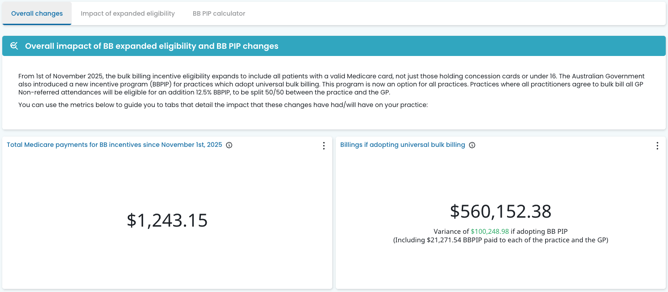
Overall changes: A summary of the combined impact of both the expanded eligibility and the BBPIP, including what you are currently receiving and what you could receive if adopting universal bulk billing.
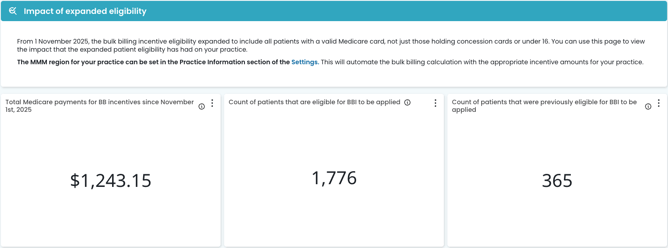
Impact of expanded eligibility: Shows the impact of the expanded patient cohort on your bulk billing incentives. Use this tab to understand what your practice is already receiving under the new rules.
BB PIP calculator: Models what your billings would look like if your practice adopted universal bulk billing and became eligible for the BBPIP. Use this tab to evaluate whether switching makes financial sense.
💡 Set your MMM region in Settings > Practice Information to ensure the correct incentive amounts are applied to your calculations.
Dashboard figures explained
Overall changes tab
Total Medicare payments for BB incentives since November 1st, 2025: This figure shows the total billings paid by Medicare for bulk billing incentives since 1 November 2025.
Billings if adopting universal bulk billing: This figure shows what your total billings would be for the same set of services if your practice adopted universal bulk billing. It includes the variance if the practice also becomes eligible for the BBPIP, and shows the BBPIP portion paid directly to the practice and to GPs separately.
Impact of expanded eligibility tab
Total Medicare payments for BB incentives since November 1st, 2025: This figure shows the total billings paid by Medicare for bulk billing incentives since 1 November 2025.
Count of patients eligible for BBI to be applied: This figure shows the number of patients who are eligible for a bulk billing incentive to be applied under the expanded eligibility rules.
Count of patients previously eligible for BBI to be applied: This figure shows the number of patients who were eligible for a bulk billing incentive under the previous rules (concession card holders and patients under 16). Use this alongside the expanded eligibility count to understand how much your eligible patient cohort has grown.
Total BB incentives — Old Cohort vs Cohort with expanded eligibility: This chart shows the trend of bulk billing incentives over time, comparing the old patient cohort with the cohort under expanded eligibility. It helps you understand the impact of the eligibility changes by showing your current incentive totals alongside what they would have been under the previous criteria
BB PIP calculator tab
This section is broken down into four additional tabs to help you assess whether universal bulk billing is financially beneficial for your practice. The four tabs include Overview, Practitioners, Service details and Modelling and assumptions.
Overview: How is the practice currently performing?
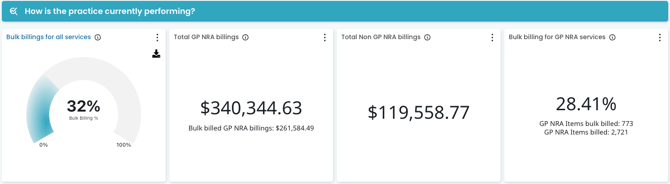
Bulk billings for all services: This figure shows your current overall bulk billing rate across all service types. Understanding this rate helps you assess your current performance and review how your billing mix aligns with your practice’s financial, operational and broader business goals.
For a detailed breakdown for Bulk Billing for all services please review our knowledge base article
Total GP NRA billings: This figure shows the total billings for all GP Non-referred attendance (GP NRA) services within the selected date range, including both bulk billed and privately billed amounts. We have also included a further breakdown to highlight the proportion of those GP NRA services that have been bulk billed, helping you understand how this contributes to your overall billings for the period.
Total Non GP NRA billings: This figure shows the total billings for all services outside of GP Non-referred attendances. These billings are not affected by the BB PIP changes, helping you understand the portion of your revenue that remains unchanged.
Bulk billing for GP NRA services: This figure shows the proportion of GP Non-referred attendance (GP NRA) services that are bulk billed out of all GP NRA services provided to patients with an active Medicare card. This is the rate used to determine BBPIP eligibility and incentive payments, helping you understand how close your practice is to meeting the required threshold.
Overview: What is the impact if your practice universally bulk bills?
If the practice adopts universal bulk billing, there are three key financial factors to consider:
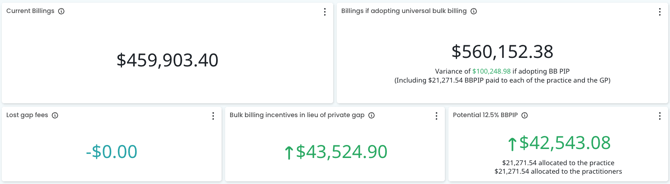
Current billings: This figure shows your total billings for the selected date range based on your current billing pattern. As this is based on historical data, it provides a baseline for comparison when assessing the impact of any billing changes.
Billings if adopting universal bulk billing: This figure shows what total billings would be for the same services if the practice adopted universal bulk billing, including the BBPIP. The variance between this and your current billings is shown alongside the BBPIP amount paid to the practice and to GPs separately. This helps you understand the overall financial impact of making the switch and how incentives contribute to the change.
Lost gap fees: Any private gap fees currently charged on relevant services would no longer apply. This figure shows the potential reduction in revenue from removing gap fees, helping you understand the trade-off involved in moving to a fully bulk billed model.
Bulk billing incentives in lieu of private gap: Where a private gap is currently charged, bulk billing incentives would replace that revenue if universal bulk billing is adopted. This figure shows the potential revenue from claiming incentives on these services, helping you assess how much of the lost gap revenue may be offset.
BBPIP: If all GPs at the practice agree to bulk bill all GP Non-referred attendances, the practice becomes eligible for the 12.5% BBPIP on those services. This is split 50/50 between the practice and the GP. This figure shows the potential revenue from this incentive, helping you understand its contribution to overall billings.
Overview: Who is private billing?
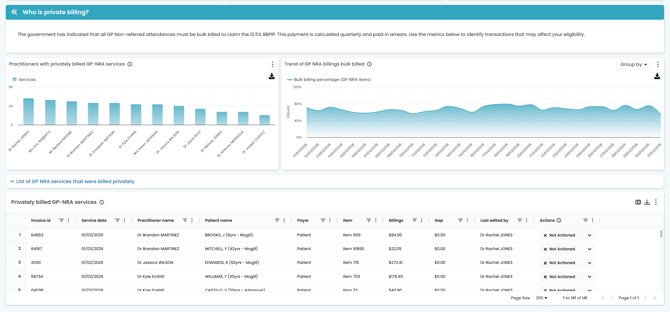
To be eligible for the BBPIP, all GPs at the practice must bulk bill all GP Non-referred attendances. Use this section to identify any services or practitioners that may affect eligibility.
Practitioners with privately billed GP-NRA services: This chart shows which practitioners have privately billed GP Non-referred attendances in the selected date range. This helps you quickly identify which practitioners may impact your eligibility for BBPIP and where changes may be required.
Trend of GP NRA billings bulk billed: This chart shows how your GP NRA bulk billing rate has trended over time. This helps you understand whether your billing approach is moving closer to, or further from, the threshold required for BBPIP eligibility.
List of GP NRA services that we privately billed: This table provides a service-level breakdown of GP Non-referred attendances that were privately billed. This helps you quickly review and correct any services that may impact eligibility.
Practitioners
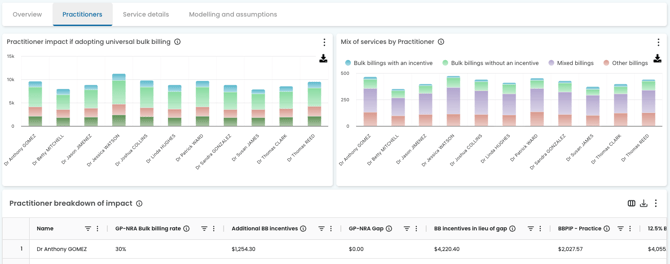
This tab breaks down the impact of universal bulk billing at a practitioner level, helping you understand how each GP may be affected and where differences in billing patterns or service mix may influence overall practice performance and decision making.
Practitioner impact if adopting universal bulk billing: This chart illustrates the impact of the proposed changes to bulk billing for each practitioner. This helps you understand how the financial impact may vary across your team and identify which practitioners may be more or less affected.
Mix of services by Practitioner: This chart illustrates the mix of services currently provided by each practitioner, grouped by how they will be affected by the proposed changes. This helps you understand how each practitioner’s service mix may influence their individual impact under a universal bulk billing model.
Practitioner breakdown of impact: This table shows the effects of the proposed changes to bulk billing for each practitioner. This helps you review and compare the financial impact in more detail to support informed discussions and planning.
Service Details
This tab breaks down the impact of universal bulk billing at a service level, helping you understand how different types of services contribute to the overall financial outcome.
Current service mix: This table breaks down services performed at the practice into the four categories described above. For each category it shows the effect of the various billing adjustments that flow on from the proposed bulk billing changes. This helps you understand which types of services are driving the overall impact and where changes may have the greatest effect.
Impact on individual services: Dive into the details of individual services to see how the proposed changes will affect a typical day. This helps you visualise how day-to-day billings may shift and identify which services may be more or less impacted.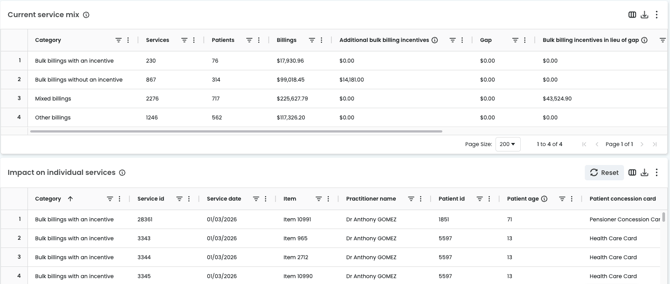
Modelling and assumptions
This section outlines how the BBPIP calculator has been built, including the intent of the dashboard, the assumptions used and any limitations to be aware of. It explains how your historical data has been used to model a consistent “like-for-like” scenario, helping you understand how billings may change if the same services were delivered under the new bulk billing arrangements.
It’s important to review this section to understand what has been included in the calculations, what has been assumed and where external factors, such as changes to workflows, patient behaviour or costs, may influence the real-world outcome for your practice.